“The magic of birdsong in the bush as day breaks … a little smokiness reminiscent of campfires and billies coming to the boil .. a full bodied and satisfying blend with subtle floral notes … a delicious satisfying blend with generous malty flavours … a delicious tea specially created to get New Zealand off to a great start every morning….”
Products
Wow, what product is that? This is the generous offer from Twinings New Zealand Breakfast Tea. And when you live in central Auckland, where birdsong is not a given, this is a very romantic image, and quite an achievement if delivered from plant material grown in Sri Lanka, India and China. It took me a long time to try this product, partly because I have my own tea habits and partly because at $6.69 shelf price per 100 gms discourages experimentation.. Tea to me though is a very personal and central part of my life, as food products are.
My own blend has more recently been a blend of Dilmah Ceylon tea, mixed with Twinings Darjeeling and Lapsang Souchon, in the ratio of 3.5 : 2 : 2. This produces a harmony of flavours, a lovely smooth, soft yet rich taste without tannic bitterness, refreshing yet warming (definite malty feel) too which is wanted for a morning drink (and suitable all day ), and the smokiness from the Lapsang Souchon is not pronounced, an underlay of something earthy and yet mysterious. I even delay breakfast sometimes to have a second cup! I should note that I add a spoon of raw sugar,, which I far prefer to the empty taste of white sugar, and use full fat cow’s milk to whiten. There are many factors of course to making a great tea, and the variability sometimes comes as a nice surprise , and sometimes not.

MyTaste Evaluation
What did I think of the Twinings New Zealand Breakfast blend? I found it strong, somewhat “chemical” and lacking in the natural plant taste I seek, and strong in a lemon taste rather than “floral notes”. Possibly the New Zealand market seeks a stronger tea, and the Breakfast teas in the Twinings range (English Breakfast, Irish Breakfast) are strong generally. Billy brewed indeed.
Pricing
There is a natural wastage in loose tea, as more is often made than is actually needed. My own blend, which I make just for myself, works out at 27 cents per very large cup. The Twinings fruit teas are close at 23 cents per cup, Twinings Breakfast tea bags 16 cents per cup. At the low bulk end, tea bags go all the way down to 7 cents a cup (Dilmah 100 packs, close to my estimate of making a cup of Dilmah loose tea on its own) and even 4.4 cents per cup (Liptons Yellow label 180 packs).
The Category
Two trends are obvious within this category, the overwhelming move towards tea bags (shelf space given to loose tea is well under 10% of the total), and the expansion into Infused Fruit and Herbal tea. These are possibly suited to a market wanting quick convenience and portion control in many current usage situations, interest in a wider range of health issues and benefits, and a gradual move away from the traditional which variety in loose tea on its own cannot satisfy. Black tea sales in supermarkets are in a declining pattern with Herbal tea (up 11%) and Green tea (up 6%) both growing in the last year on top of good growth the year before that. Having said that, Black tea remains 60% of sales. Generally the market gets the product it wants, but the loose Twinings tea I buy is not available in tea bags, and is not stocked by Countdown at all, so trends become self fulfilling.
Infused Fruit and Herbal teas are not made from Camellia Siinensis, the tea plant, are caffeine and tannin free. Interestingly, Ready to Drink / Iced Tea makes up just under 9% of sales, declining slightly in the last year.
What I would Like to Taste
Twinings Pomegranate and Raspberrry ($4.69 / 20 bags)
Twinings Apple and Pear (as above)
But … would I miss the tannin ?

Postscript : Adjusting to Soymilk
The change to Soymilk (see… Soymilk : Grown, Not Stolen), totally changed the taste of the tea blend I had carefully worked out. The smokiness of the Lapsang Souchon was lost, and the soy dominated. A stronger solution was required.
I found the initial answer in the Twinings NZ Breakfast Blend that I still had in the cupboard. I had thought that the soy was crying out for a lemon edge, and although the pack describes the flavour as “floral notes”, lemon is what I detect. There is no conventional Ingredient Listing on tea packets as there is in many other food categories, yet it would not seem to be a single ingredient formulation. The :generous “malty flavours” mentioned on the pack suit the malt character of Calci Plus … keeping the base teas of Dilmah and Twinings Darjeeling, and adding Twinings NZ Breakfast Blend produces a flavoursome, satisfying tea that once again I look forward to enjoying, the soymilk flavour harmonising well.
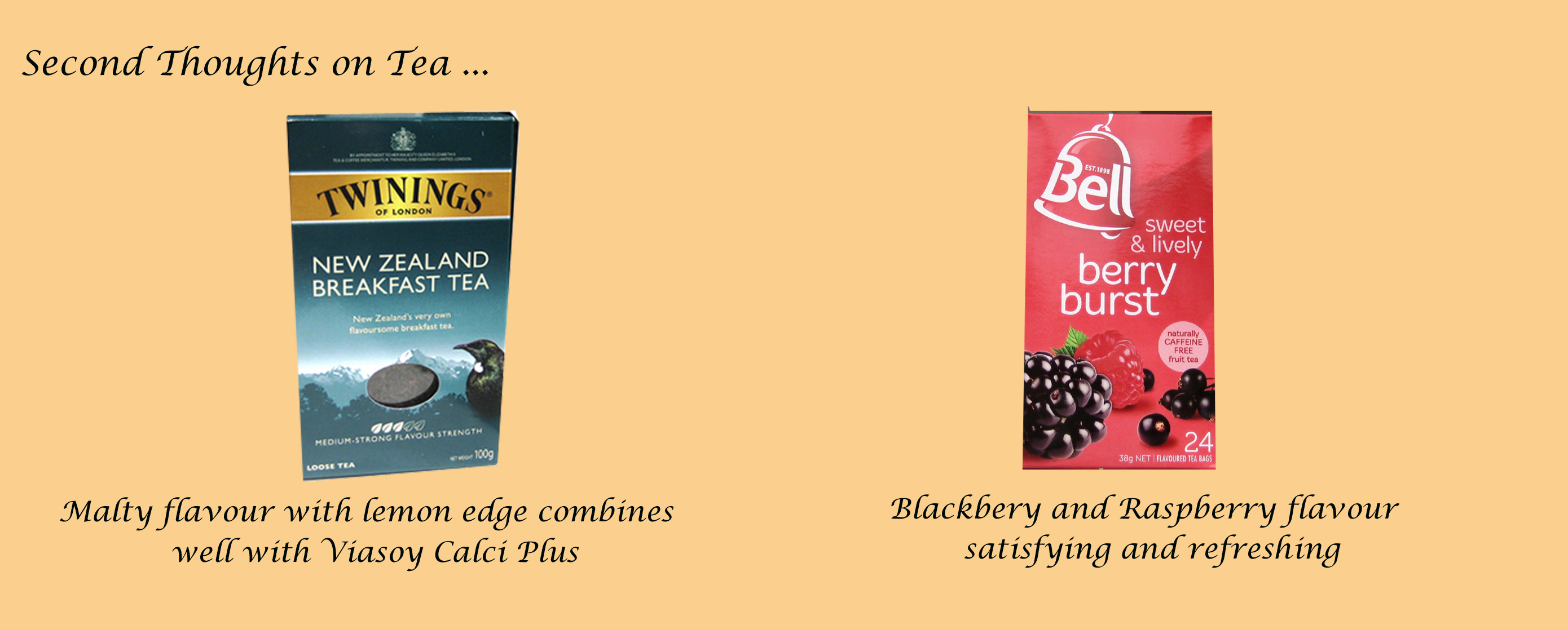
For my office requirements I have dropped black tea altogether, and started on the fruit infusions referred to above. An early leader is Bell Berry Burst. The Raspberry and Blackberry (apparantly along with added Blackcurrant flavour) justifying the pack description of “Sweet and Lively”, a refreshing mid morning pick me up.
More on this category to come …..
…and No, I don’t miss the tannin!
